Over the past five days I had more than my share of bacalhau, coffee, pastéis de nata, and wine. Back to London for some detox.
Photos of Portugal are coming soon...
Over the past five days I had more than my share of bacalhau, coffee, pastéis de nata, and wine. Back to London for some detox.
Photos of Portugal are coming soon...
After two days in Portugal it was time to head into the heart of Porto, Portugal's second city and home of countless wineries dedicated to producing port wine (this is the only part of the world where port is made)
Porto didn't strike me as a very big place when we walked out of the train station. It was a beautiful view though: narrow brick paved streets stretching all the way to the river Douro, on both sides a single wall of very old Portuguese style buildings which didn't leave much room for the sunlight to come through, giving the city an almost medieval look.
As soon as we stepped on to the city's brick streets we headed for the Porto Cathedral, atop of a hill and seen from most parts of the city centre. What from outside looked like a castle actually housed the cathedral and a museum of sorts which had very few but interesting things on display, including samples of ancient hand painted tiles, and a reproduction of two pages of the first book ever printed in Porto, in the early 1400s. It was ancient Portuguese and I was struggling to even read the first line.
We didn't linger for too long in there as it was very cold and most of us (apart from Isabel!) were very unprepared for it. So we headed out into the sun towards the river for a Portuguese latte (meia de leite)
Beautiful view from down there -- it is definitely the image of Porto that I will take with me. All the charming old houses are very colourful and well looked after, and there are lots of cafés and restaurants where you can relax and enjoy the view while having a cup of coffee or some bacalhau à moda da casa. The whole area along the river's edge is kind of touristy but still nice.
Along the opposite edge of the river sit all the main caves (or wine caves) where later that afternoon we went on a wine tour and tasted a couple of varieties of port (the tour/tasting costs €3.50 which you can discount off the price of one wine bottle at the end -- should you choose to buy one). All the grapes and most of the port is actually produced elsewhere, upstream the Douro, but all the main wineries keep cellars and shops in the city centre where they are conveniently within reach of the tourists's pockets.
We then took a bus tour around the city which was okay but a bit too rushed for me. I need time to walk around the buildings, look at the shops, people walking by, and take photos. But I went back to most of the same locations the following day when I was by myself and could take my time.
Halfway through the bus tour we stopped at the beach for a delicious lunch by the sea (I had bacalhau, of course), then back to the city centre for the wine tour, and straight home to warm up!
The thing that struck me most about Porto though were the hand painted and patterned tiles which are everywhere and give the city a beautiful, uniquely colourful look. But apart from the more touristy areas, the buildings are very poorly looked after. Many look or are abandoned, with broken doors/windows, and I was shocked to see that people still lived in them.
Paredes is a town about 30 minutes east of Porto. It's a very quiet, cute little town with a couple of busier streets, a main square and a church which at night is beautifully lit up. It reminds me of countryside Brazil.
We spent Christmas with Isabel's family here. On Christmas Eve we had a lavish meal of potatoes, bacalhau (cod) and vinho verde (green wine), followed by about eight different kinds of cakes, some port wine, and finally coffee: a single shot, black, with sugar, served in a tiny cup. Just as it should be.
After opening the presents (as in Brazil, this is done on Christmas Eve, not Christmas day) and chatting for a bit over a few more drinks, we went to bed and had a good night sleep.
The next day I woke up very early and instead of sitting around waiting for everyone else to wake up, I decided to go on a short stroll to get acquainted with the surroundings.
As expected, before 8 a.m. on Christmas day the town was deserted. It was a frosty morning and the air was very crisp but the low morning sun made it a perfect morning to walk around. I walked past a couple of older men making their way to the Christmas service and decided to follow them into town, across the bridge over the train station.
What I saw on the way made me forget I was in Portugal, taking me straight home: the cafés with people sitting at the bar, the tiny shops with familiar names, the old folk saying hello as they passed by, the quaint houses decorated with patterned tiles, the architecture, the narrow brick paved streets.
Despite feeling at home, me and my big old camera certainly didn't belong there. At one stage this old lady walking past asked me why I was photographing the houses, particularly the abandoned/neglected ones! Somehow I thought she wouldn't quite comprehend, or care for, my obsession with urban decay so I just told her I was a tourist which seemed to have been a good enough reason as she went back to her business and let me be.
After a quick and painless train ride from Brentford train station to Gatwick Airport, Grazi and I went straight to the TAP check-in counter to get rid of our heavy bags. Much to our surprise, the lady told us we were flying business class!!
Whether it was a mistake when booking the tickets, or they just decided to bump us up because we are such nice people, the fact is that we are now sitting in the business class lounge waiting to board. It's kind of average, really. (had this happened in Heathrow's new terminal 5, or somewhere like Singapore, I am sure we would have been much better off) But we do get free food so I'm not complaining.
Yes, yes, I know I have barely arrived in the UK and I'm already flying out. But it's Christmas! And our friend Isabel has kindly invited us to spend Christmas in Portugal with her family.
So we're heading to Porto (where the port wine comes from!) for five days of sightseeing and gorging ourselves on delicious Portuguese wine and food. Can't wait!
Time to start again. I am no longer in limbo. I've been at the São Paulo airport for hours and the flight to my new home departs in about an hour. I am excited and anxious at the same time.
But it's the journey that counts, not the destination. And so far the journey has been a hell of a lot of fun.
"If we do not find anything pleasant, at least we shall find something new" -- Voltaire
I have just posted the photos I took during my three days in Santiago -- to go with the latest posts.
Here's a preview:


All the photos can be found here: http://www.flickr.com/photos/meurer/sets/72157610292798332/
Enjoy!
Landed in São Paulo. I have been in the country for less than two hours and already it's driving me crazy. I keep being reminded of all the things that make me not want to come back to live here. That's ok, deep breath... count to ten... it's only for three weeks. At least I'll get to see my family in a few hours.
I miss New Zealand.
Woke up early this morning because I am heading to the Concha y Toro winery. Can't believe how excited I have been about this till now. First, because I will be heading out of Santiago for the first time, I will get to ride the train on my own, and I will get to visit one of the main wineries in the world (I didn't know this but Concha y Toro is amongst the top 10 wine producers in the planet)
The tour ended up being just ok but at just NZ$15 I couldn't really ask for more. It included two wine tastings (you had to pay extra for more), plus a walk around the vineyards and got a visit to the famously grim Casillero del Diablo (the devil's cellar). Transportation to the winery is a breeze: catch a couple of trains south, then a quick taxi or bus ride to the winery.
Since I had seen pretty much all I wanted to see in Santiago, on the way back from Concha y Toro I decided to stop at a huge mall I had spotted on the way there. It's located right next to one of the trains stations south of Santiago. I did some window shopping (prices were actually quite low as compared to New Zealand but I just didn't have ANY space left in my luggage), had lunch, and went on to watch Blindness at the movies. I can't believe the ticket only cost me about NZ$5!! The movie, by the way, is incredible. I had read the book by José Saramago a few years ago and it was quite impressive, but the movie gives visual life to a chaotic world where people start to go blind. Most of the movie was shot in São Paulo which gives it a unique run down look that only adds to the mood.
After the movie I headed back to Santiago and I thought it was time for one last café con piernas. I loved the thing. Even better, when I walked out of the café it was rush hour and a multitude of people were gathered on the paseo (a street exclusive to pedestrians) looking up at a huge screen showing a football game Chile vs. Spain. It's like everyone just stopped on their way home to watch the game. I hadn't seen such a thing even in Brazil, where we are supposed to be crazy about soccer. I managed to get some good photos, and stuck around for a while watching the game amongst the crowd. In case you were wondering, Chile lost 3x0.
Then it was time to get ready to leave. I had dinner at a way below average Italian restaurant (which was surprisingly crowded) but at least managed to have some good Chilean wine. Tomorrow I am back in the motherland.
Today I was planning to walk all day long so I thought I'd better start with some breakfast.
I headed to Café Haiti in the financial district for a typical Santiago breakfast: café con piernas. Yes, you heard it right: coffee with legs. You pay for your coffee at the door (cappuccino for me) and then hand the receipt at the counter to one of the waitresses who will bring you your coffee. What about the legs, you ask? Well, the thing is all waitresses are wearing high heels and incredibly short skirts! The environment is surprisingly conservative though, and most customers are businessmen on the way to or on a break from work.
As I walked out of Café Haiti I heard a very loud protest not too far away. Sensing some good photo opportunities I decided to run after the mob but I was too late and I couldn't track them down. Oh yes, half the population of Santiago seems to be on strike. In my three days here I saw at least a dozen different strikes around the city. Strikes are such a South American thing, I had completely forgotten about them. You'd think we are descendants of the French.
I then moved on to some of the common tourist destinations of Santiago, all nice enough but nothing special: Palacio de la Moneda (the presidential palace, which is quite compact when compared to its Brazilian and Argentinean counterparts), the Museo Precolombiano de Arte Chileno for some history lessons on the pre-Colombian civilizations in America, and the Plaza de Armas, Santiago's central square where the city was founded.
I decided to go on a bit of a longer walk north as I was determined to visit the Mercado Central, where you can buy (very cheap) a wide variety of fish and all kinds of seafood imaginable. In the market there are also countless restaurants (not so cheap) where you can try some of the food. While Santiago's Mercado Central is very nice, it is getting a bit too touristy for my taste, and I think the central market in Florianópolis is nicer both inside and outside, and you can walk around without being hassled by waiters trying to get you to eat at their restaurant. Plus, the food in Florianópolis is better as well.
After lunch at the market I was so tired that I walked back to the hotel for a siesta. When in Rome...
Some sleep was all I needed to recharge the batteries as by 3 pm I was ready to head out to Cerro Santa Lucia, a park built on and around a small mount sprouting right in the middle of the city centre. This was the highlight of the day, maybe because I wasn't expecting much. But the park is definitely worth a visit. It is full of plazas, viewpoints, statues, love seats, narrow stairways, and hidden corners to explore. If you climb all the way to the top (quite a hike!) you get a 360 view of Santiago, and a nice view of the Andes as far as your eyesight will stretch (or as far as the smog will allow). You also get a privileged view of Cerro San Cristóbal, Cerro Santa Lucia's big brother where Santiago's Zoo is located. I walked about 25 minutes all the way to Cerro San Cristóbal but unfortunately it was closed due to a strike. Later when I got to the hotel I learned that the walk to San Cristóbal didn't have to be a complete waste as I was a short stroll from Pablo Neruda's house-turned-museum but missed it. Doh!
Then it was time for a quick dinner at the Barrio Bellavista with a couple of other tourists I met at random and take the subway back to the hotel for a good night sleep. Tomorrow I've got some wine tasting to do!
I have just arrived in Santiago and frankly I am a bit lost. It always happens. The first couple of hours in a foreign land are always the hardest. You have no idea where you are. You don't trust anyone. You look at the city map, it doesn't mean a thing to you and you don't know how to get from A to B. My first impulse is to stay locked in the hotel room. It's a comfortable place where I know I am safe. Part of me is saying "you could just stay in here for all three days and watch TV" but a few minutes later I come to my senses and push myself out the door.
It's past 4 pm so I decide to just go on a recon mission. No maps, no camera, no backpack. I try not to dress like a tourist so I can just walk around unnoticed and get a feel for the city and the people. It's so hot I decide to buy a bottle of fresh water (sin gas!) There's a tourist alert right there. But then I notice that many locals are also walking around holding a bottle of water. It's all good.
I hadn't noticed on the way from the airport but from lots of places in Santiago you can actually see the Andes. Well, barely. The smog which covers city makes everything very hazy. But they're there. And you can tell the mountains are incredibly high, like a huge wall protecting Chile from the rest of South America. it's hot as hell down here (30+ degrees) but the mountains in the distance are still covered in snow.
I turn away from the Andes and continue walking along Av. Libertador Bernardo O'Higgins, which seems to be Santiago's main street and borders the city centre to the south.
It strikes me how tiny Santiago's city centre is. In my short stroll I walked past several of the places I will be returning to tomorrow with a little more time and (more importantly) my Canon SLR. Cerro Santa Lucia, Palacio de la Moneda, Biblioteca Nacional, Museo Chileno de Arte Precolombiano, Plaza de Armas, Catedral de Santiago, Mercado Central: they are all within 5-10 minutes walking distance from one another. Santiago is going to be a walk in the park.
Then I noticed something: stray dogs. They are everywhere. But they are not like the stray dogs I've seen in other countries. For one thing, most of these are big, the size of German Shepherds, and look well-fed and healthy apart from their badly kept coat. But the most bizarre thing is how they are strategically stationed at the traffic lights, one or two dogs per set of lights. It's like that is their territory. When pedestrians are crossing, they sit calmly at the kerb, just watching everyone walk by. But as the lights turn green, they go postal and start attacking the cars going by at 60km/h!! I am surprised I didn't see any of them get run over.
As it was getting close to 7 pm I decided it was time to find a place to eat. Luckily enough I was just next to Cerro Santa Lucia when I saw a sign saying Barrio Historico so I decided to see what that was all about. It turns out I was walking into Calle J. V. Lastarria which sports a nice collection of al fresco cafés and restaurants. After walking around a bit I chose to go back to the first one I saw, called Patagonia (which I can recommend) and had the most amazingly cooked steak with quail eggs and potatoes, preceded of course by a delicious Pisco Sour, one of Chile's signature cocktails (it tastes much like a caipirinha!)
Now I made it back to the hotel. I am very tired and very jet-lagged. Will talk again tomorrrow.
Today is the day I leave New Zealand. Been feeling a little funny all day, a bit like getting butterflies.
The last few days have been incredibly busy. Friday was my last day at work, and a night Olympic threw a huge farewell party. Then I had my own farewell party the next day which went on till early Sunday morning. Yesterday (Sunday) was a day of shopping and generally sorting things out the last few things. Thiago and Karla took me out for breakfast, and Ivy and Ken took me out for a delicious Japanese dinner at the viaduct. And this morning Sheba picked me up and took me out for breakfast in Remuera (I chose the location, strategically opposite Dick Smith because I still had some last minute shopping to do!)
Warner, Sheba, and Sunny came to see me off at the airport which was great as I would hate to be waiting there by myself. We had a coffee and took some funny photos of them trying to keep me from boarding (which I'll expect to see in the next edition of the ASD magazine!) but I am sure I must have seemed a little "out" since all I could think about was that in a couple of hours I was going to be leaving New Zealand for what may be a very long time.
Board the plane. Thirteen hours later and I am in Santiago de Chile. Just in case I had any doubts as to where I was, the chaos at the arrival area and all the yelling and pushing and taxi drivers hassling me confirmed that this was indeed South American soil.
So let's see what Santiago is all about, shall we.
I've been wanting to write this for such a long time but haven't been able to find the time or the inspiration. I have always found that with me, inspiration comes when I am away from home. Sitting here on the deck of a bach twenty meters away from the Pukehina Beach sands with a glass of wine and what would be complete silence were it not for the waves breaking before me as they are lit up by the low afternoon sun, I suddenly feel the urge to write.
After I am done thanking the god of laptops and cordless devices (alas, no power points in sight out on the deck) I begin to think that I couldn't have asked for a better setting to write this article. A weekend away with friends in a quiet place by the beach, good wine, good food, good chats and good laughs. And I am thinking this is exactly why I fell in love with New Zealand in the first place: the quiet, laid back life style, the beautiful scenery, and how easy it is to just get away from city life whenever you feel the need to.
Now I am leaving New Zealand and it makes me sad despite all the new adventures waiting for me abroad. It's more of a mix of wanting to go but not wanting to leave. Five years ago when I was preparing to leave Brazil for a new life half way around the world I couldn't have pictured, in my wildest dreams, that things would have turned out the way they did.
New Zealand has been good to me.
Here I found a job that I truly enjoy, where I have friends, peers, heroes, and followers. Aside from the professional growth and all the opportunities given to me, Olympic has been key in supporting all other aspects in my life in New Zealand, from friendships to travels to personal development.
Here I found true friends. People I deeply care about, and who also care about me. Friends who I'll keep in touch for years and years to come, and will certainly get to catch up with many times in our travels around the world.
Here I found places to go. It goes without saying that New Zealand has wonderful scenery. But it's a funny thing, living abroad. You get to spend the first year or so living as a tourist and end up seeing more of the country than most locals. Then you start to settle, routine kicks in, and you experience the life of a local.
Here I found a new take on life. My short stay here couldn't have been further from my original plan. And it could hardly have been any better. Now I am finding it much harder to leave New Zealand than it was to leave Brazil. Which only goes to show how much more at home I feel here, amongst this myriad of cultures, religions, and ethnic food. My roots are in Brazil, and so is my family. But a good chunk of my heart is here.
Pause here. I just went over the text again and realised I am struggling to find the right words. I suppose all that I am trying to say is that I am very grateful for all that's happened in the last five years. And I already miss everyone and everything about New Zealand.
I need to be going now. The sun has set and it's getting cold out here. In the distance I can see a storm coming. But mostly, the laptop battery is running out and inside the house everyone is gathering around the table because Sheba's home made curry is about to be served. I couldn't have thought of a better ending myself.
I will so miss you all.
My good friend Juliana (or simply Ju) came to NZ for a visit last week. It was awesome to see Ju again, hang out with her, take her around the country, and have some good chats. I just realised that we've been good friends ever since we were exchange students in the US (13+ years ago) and while we only get to catch up every one or two years we've always kept in touch.
We went to Mt Ruapehu with my work mates and Ju came along. Two days of snowboarding, a drive up to Taupo and Rotorua, and a few luge rides. Great fun!


What we didn't expect was that people here would find it extremely odd hearing an Asian girl speaking perfect Portuguese. Or speaking English with a Brazilian accent. Ju got several remarks from my Asian friends, but the truly surreal experience was at her last night here when we were having dinner at a Thai restaurant in Parnell. The waitress (Asian, presumably Thai) kept staring at Ju the entire evening, what made her feel quite uncomfortable, but I was laughing my head off.
Good times. Valeu Ju!
Acabei de voltar de uma semana inteira snowboarding em Queenstown.
Queenstown é uma armadilha para turistas em tamanho família. Tudo é inflacionado, da diária do hotel, a restaurantes, a lojas de grife. Mesmo assim Queenstown está sempre cheia durante o ano inteiro. No verão, esportes radicais tipo skydiving, bungee jumping, shotover jet, paragliding. No inverno, montanhas cobertas de neve e vários ski fields por perto. Adivinha porque eu fui.
Algumas fotos de Queenstown coberta de neve:

A caminho da montanha:

E lá em cima!


Voltando da montanha:

Mais fotos aqui: http://tinyurl.com/6bn536
Duas curiosidades sobre Queenstown: tem mais leitos de hotel do que habitantes, e é a cidade da Nova Zelândia com mais brasileiros per capita. Pode?
Antes tarde do que nunca...
I had posted these photos of my trip to Sri Lanka and Bangkok to flickr a while ago. Here they are:
Last day in Sri Lanka. Woke up in Kandy, the country's cultural capital. I didn't have much time there so after breakfast it was off to the main attraction in Kandy: the Temple of the Tooth Relic.
That's where they keep the Buddha's left canine tooth! I actually thought that was kind of creepy. The tooth was snatched from the Buddha's cremation chamber and it eventually made its way from India to Sri Lanka. What's even more creepy is that the tooth is paraded around the streets of Kandy every year in the Esala Perahera festival. The festival is supposed to be great but I am not so sure I am sorry that I missed it.
The temple itself is actually very nice. What struck me most about the place was that as you are walking towards the entrance to the temple there is a beautiful garden with several statues and they all have their back to you. Of course there's a reason for it: no one should be standing with their back to the Buddha -- and I suppose that include statues!
Leaving Kandy, on our way to Colombo we stopped at the Elephant Orphanage in Pinnawela. As it turns out the war is going on in the elephants natural habitat and is hurting them. Many are being killed by land mines or left homeless. Some of them are brought to the orphanage where they are kept in semi wild conditions.
I had lots of fun having lunch while watching 60 or so elephants in the river only a few meters away. They were bathing, playing, and generally just being elephants. One of them had three legs from stepping on a land mine. He still walks down to the river and back to the orphanage every day.
Once I had enough of elephant watching we made our way back to Colombo. I only had time to take a shower, get my bags, and head to the airport. I'll be lucky to get a couple of hours sleep on the plane before I start a brand new day in Bangkok.
I spent my last two days in upcountry Sri Lanka which is one huge World Heritage site. The first day was a very long one: Wake up at 5:00 am to get ready for the long drive to the ancient ruins of Sigiriya.
Two short but very good stops along the way. First for breakfast, at this restaurant in Kurunegala. It was clearly a restaurant for tourists but nevertheless I had one of the best meals during my stay in Sri Lanka. When asked how hot I wanted the food I said medium which was probably cheating but I don't care. Bread, a delicious fish curry, potato curry, coconut sambol, fresh papaya juice, and to top it all a cup of hot sweet tea with milk. Simple but oh so good. I was sitting outside in the cool breeze and my table had a nice view of the Eel Rock (Kurunegala has seven animal rocks, naturally shaped of course.)
The other stop was in Dambulla which single most popular attraction is an ancient cave temple with over one hundred Buddha statues dating back to the 1st century BC.
Dambulla was on the news not too long ago. Last February a girl with links to the LTTE got on a bus on its way to Anuradhapura. She got off a few stops later but not before setting the timer to the bomb left underneath her seat. 20 people killed, 50 injured. I saw it on the news when I was in Brazil last summer and remember thinking that if that kind of thing went on I would have to cancel my trip to Sri Lanka. I am glad I didn't.
On to Sigiriya. Fabulous place. The story goes like this.
Around the year 500 BC there was this evil prince who for some reason or another got annoyed with his old man (the king) and killed him. His brother didn't like it and wanted revenge but the evil prince (who was now king) won the fight and the brother fled to India. The evil king didn't feel safe though because he knew his brother would soon come back to get him.
He then found the perfect location for a new fortress/palace where enemies could be spotted from miles away. The evil king proved himself to be quite the visionary. The palace and the fortress around it were build during seven years by 12,000 slaves and it an impressive display of engineering, stuff that gets you thinking "How on Earth did they...?" It was also an amazing display of about 500 frescos of beautiful ladies (the king's personal harem) painted in the many caves around the fortress.
Anyways, after a few years the brother did come and the evil king ended up committing suicide in the battlefield. What a way to go. The brother then became king and everyone lived happily ever after. Except for the paintings, that is. The palace was given away to monks who used the place for meditation and the paintings of lovely ladies were too much of a distraction so they decided to destroy them. Just like that. Only about 20 paintings are left but they are so worth the trip.
After that it was time to go to Kandy and get some sleep!
Sri Lankan cuisine is the ultimate finger food. That's because you eat it with your fingers! My opinion is that it doesn't taste as good if you use cutlery, it's like drinking wine out of a paper cup.
Eating with your hands is harder than it looks. They have a particular way of handling the food with their fingers which I'm yet to master. It's all about mixing the right amounts of each dish on the plate so it's the ideal consistency to grab it with the tip of your fingers and put it in your mouth. I thought it would come naturally to me but it didn't: I'm sure I look very clumsy doing it. But I must say it feels really good, it's quite liberating. I asked Dishal, one of Bhagya's cousins, whether he thought it was easier using the fingers or a fork. "My fingers of course" he replied with no hesitation. I beg to disagree! It IS harder. But it sure is more fun!
I don't think the average Sri Lankan home keeps lots of forks and knives around. When food is served only the food dishes and empty plates are at the table. All restaurants have a sink close by where you can wash your hands before and after eating. But if you must use a fork I am sure any place would be able to provide one. I went to a fancier restaurant where cutlery was already at the table. You would also use it in places like food courts and weddings where it's not really practical having hundreds of people wanting to wash their hands at the same time.
Today was my first day by myself in Colombo and I was quite excited about it. Sasanka had weddings preparations to tend to so he dropped me off somewhere along Galle Road and I was on my own.
What a difference it makes not having a local close by. People approach lots more, for better or for worse. School kids smiling and waving at me, people stopping me out of the blue and asking me questions like were I am from, how long I will be staying around, do I smoke (???)
But I did also get heaps of tuk-tuk drivers harassing me to take me on city tours, shops, or back to my hotel (I lied to them all and said I was staying close by and would just walk.) Most would give up after a simple "no, thank you" but some are quite persistent and I even had a couple of guys posing as cops and trying to rip me off big time. I won't go into details here but suffice to say that while they didn't manage to get any money out of me things did turn a bit nasty. I was a bit shaken by it all so instead of taking a tuk-tuk home like I had planned I decided to call Sasanka and ask him to pick me up.
When we arrived the house was packed with relatives, mostly people I remembered meeting at the home coming a few days ago. They all came to work on some last minute details for the wedding. We all had dinner (no curries this time, mostly breads, rolls, sandwiches, and papaya, banana and pineapple for dessert) and then it was time to get to work and package the cakes. I'll explain. All guests at the wedding and at home coming get a little wedding cake nicely packaged in a bag or a box. I tried it a few days ago, it is delicious and very rich. Having 600 guests (300 for the wedding, 300 for home coming) means you need to idividually package 600 cakes so I rolled up my sleves and helped them although I kept thinking how nice it would be to have one of those babies as I was handling them. The boxes are usually purchased in specialised shops but in this case Sasanka's father Mahasen, who is a bit of an artist, handcrafted each of the 600 boxes himself! It was awesome spending time with Sasanka's family and helping them with the work, it made me feel like I was part of the whole thing.
Then they all went on to discuss exact timings for each activity during the ceremony. All in Sinhalese of course, which alas isn't my forte so I decided to be anti-social and come up here to write these notes.
All in all it was an interesting day with a very nice ending. A few notes to self:
Today I left for my first ever trip to Asia. First a long and what turned out to be not-so-painful flight from Auckland to Bangkok. A brand new Airbus from Thai Airways with a personal screen and remote control for each passenger which allowed me to watch three movies throughout the entire trip made it all mush less painful.
I had 90 minutes to kill in Bangkok which seemed plenty until I saw the size of the airport. The transit area is simply huge. It took me 30 minutes to walk from the departure gate to my boarding gate doing a lot of window shopping at the duty free shops. I figured since I was in Bangkok I might as well have some Thai food before my second flight.
Lots of restaurants, delis, and cafes to choose from, many of which serving Thai food. I settled for a nice-ish one close to my boarding gate so I wouldn't risk losing the flight. I ordered Pad Thai Goong and some Thai Iced Tea which is like iced tea but with coconut milk. Very yummy indeed. I need to remember to have some more once I'm in Bangkok next week. I had heard that sugar is a key ingredient in Thai dishes (even the savoury ones) but I was still quite amused to see a tiny bowl of sugar brought along with the traditional salt and pepper. The entire meal cost me 300 baht which is about NZ$12. Given that this was at the airport I figure it will cost me about half as much in the city. A similar meal at the Auckland airport wouldn't cost less than NZ$20.
You can certainly appreciate the fact that the Bangkok airport is the main hub for exploring southeast Asia. Bangkok is after all strategically located. And the airport is, I'm told the second largest in the world. While walking through the transit area I must have heard at least a dozen different languages and saw people of every ethnicity and nationality I could think of.
The flight to Sri Lanka was an endless three hours. But then it would be, since I had been on a plane for 13 hours before that. I was amused to see that they served curry for dinner, something I had never seen before on a plane. It just goes to prove how little I know about the world around me!
Brazilians apparently are very scarce in Sri Lanka. Even the immigration officer seemed amused to see me ("Oh, you are from Brazil?") Given that tourism isn't what it used to be around here I wouldn't be surprised if I was the only Brazilian in the entire country at the moment.
Sasanka was of course late to pick me up (I wasn't surprised by this as you wouldn't be either if you knew Sasanka well.) This gave room for taxi drivers and tour guides coming up to me every 30 seconds and asking whether they could arrange a hotel or a tour around the country I felt like going "It's past midnight! I don't want to go on a blimming tour!" Oh well. Everyone is a bit edgy after a long flight. They thought I was a poor lost whitey, which I was until Sasanka and his friend Gihanta showed up.
They took me to a very simple restaurant on the way to Colombo to get some food. My first Sri Lankan meal within one hour of being in the country, not bad! We had Kottu Rotti which apparently is a very traditional dish and a must have while in Sri Lanka. Well I can tick this baby right off my list! To drink we had tea with milk, very hot and very sweet, just as they drink it here. I insisted on eating with my fingers even though the waiter brought some forks (which they probably only did because I was there.) A meal and drinks for two (Sasanka didn't eat) came out at 320 rupees which is about NZ$4. And I thought the Pad Thai was cheap. After leaving the place Gihanta told me that as he was paying the bill he was told I was the first foreigner they ever had eating there.
The traffic on the way to Colombo was very chaotic which is saying a lot because it was close to 2 AM. I am afraid to think about what it will be like during the daytime.
Sexta-feira de manhã estarei fazendo minha primeira viagem pra Ásia: tenho um casamento para ir em Colombo, no Sri Lanka. Vou aproveitar e ficar um tempo por lá pra conhecer o país, visitar templos budistas, viajar de tuk-tuk, comer curry com as mãos, andar de elefante, curtir o calor equatorial, passear pelas praias e, se der sorte, ver tartarugas-marinhas selvagens. Na volta vou parar em Bangkok, na Tailândia, por três dias e tentar mergulhar mais ainda na cultura asiática.
Dá um friozinho na barriga ir backpacking sozinho pela primeira vez, e ainda por cima em países "orientais," sem falar os idiomas locais. Mas ao mesmo tempo estou contando as horas. Há cinco anos atrás nunca teria nem passado pela minha cabeça que um dia eu estaria fazendo uma viagem dessas. Mais uma razão para ter saído do Brasil!
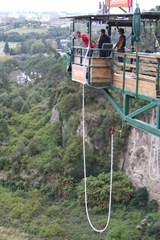
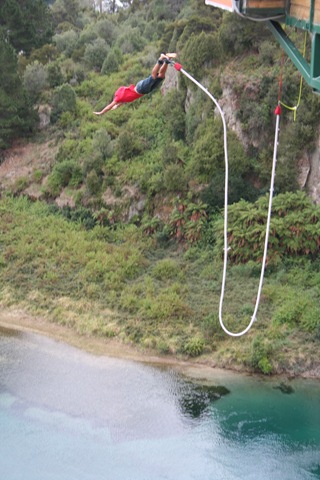
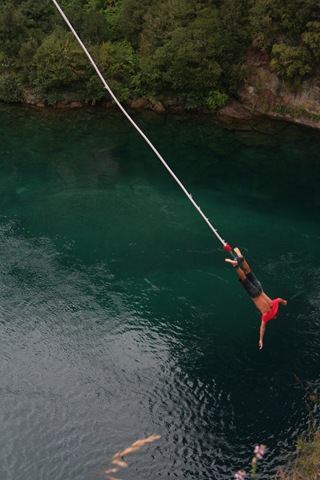
Não posso chegar perto de um bungy que tenho que pular. Desta vez foi em Taupo. Estávamos passando o final de semana por lá com uns amigos da Grazi e deu na telha de pular.
Foi meio de repente, então nem deu tempo pra ter medo. Quando me dei conta já estava com os pés amarrados na beirada da cabine, 50 metros entre eu e o rio. Foi aí que deu o frio na barriga e a idéia de voltar atrás não parecia assim tão vergonhosa.
Mas aí já era. Só tinha uma saída dali e era pelo barquinho amarelo me esperando lá embaixo para literalmente me rebocar até a margem.
1... 2... 3... bungyyyyyyyyyyy! :)
This is suddenly a hot issue in New Zealand again after another shit for brains politician desperate for votes made some comments about mini-Chinas and mini-Hong Kongs being formed throughout the country. Being an immigrant myself (though often not immediately identified as one because I'm not Arab or Indian or Asian) I can't help but write my own thoughts on the matter.
I won't even mention the many comments radically against immigration for the simple reason that people who make those sort of comments usually bring nothing of value to the discussion and seem to have no real justification other than their own racist feelings. If you don't want to be living with other cultures then you should know that the 21st century is probably going to be too much for you to handle, buddy. There, I said it.
But I have also heard comments along the lines of "I have nothing against immigration as long as immigrants adapt to the local culture and don't settle in their own communities and start opening shops and changing the look of suburbs, etc."
Well a country can choose whether or not to let immigrants in, but it cannot dictate what people do once they are in. Some immigrants will adapt and slowly cut their links to the homeland. Some will refuse to immerse themselves into the local culture and will form closed communities. And then there's all the rest in between. I like to think I lean towards the former but that's really just a personal choice of trying to get as much as I can from other cultures at the cost of my own.
Ultimately people are just trying to fit in wherever they can and if isolated communities of immigrants are such a problem then maybe we should think about why is it that they are being formed in the first place. Could it be the case that immigrants are not feeling welcome so they need to turn to people of their own culture who are more likely to accept them?
What's more, what's so wrong about forming small ghettos and communities anyways? Surely New Zealanders who go abroad try to find each other and stay in touch. It gives people a sense of belonging and helps them feel at home in a strange land. In fact, all white immigrants tend to form their own communities in New Zealand as well, they are just not as noticed because a) there's probably not as many of them, and b) they're western so it's like they are "one of us".
I hardly ever hear a word about South American immigrants either. I know for a fact that there is a large Brazilian community in Auckland for instance, and it is at least as isolated as any Chinese community out there (I know some Brazilians who have lived here for years and can hardly speak any English. My opinion? It's their loss.) I wonder if they don't get noticed because their eyes and noses and skin colour look very much western so you don't get to see packs of Brazilians roaming up and down Queen St even though there are many.
Also, why is it that we never hear anyone complain about immigrants when ordering the curry of the day at the local café or when filling their supermarket trolleys with ethnic food without even realising it? Or when immigrants win us medals at the Olympics? Or when our best mate is an immigrant, or their parents are?
Just to get a little perspective, can anyone in New Zealand really consider themselves to be "locals" in the first place? After all weren't Europeans immigrants on this land not too long ago? Back then weren't Maori the locals and the European the ones who started to spread, create their own ghettos and disseminate their culture?
One could argue that citizens of developing countries are less likely to have reservations about immigration because we're the ones doing it now. But maybe it's because we have been hit by several waves of immigration for hundreds of years and we've come to appreciate it.
New Zealanders should try and realise how lucky they are to live in such a culturally diverse place and reap all the social and economic benefits that come with it. Enough with the go-back-to-where-you-came-from crap, how come I never got that?
Can you imagine how incredibly boring the world would be without the cultural mix?
Summer was pretty good in Auckland, or so I am told. Too bad I was in Brazil, enjoying an even better summer haha.
Well it seems that as soon as I arrived in New Zealand things started to get ugly. The first two weeks have been alright, but this weekend has been the worst. Cold, nonstop rain, winds, the Starlight Symphony at the Auckland Domain had to be cancelled,...
And to top it all, it's Sunday afternoon and I am at work. This is what you get for not doing your hours during the week, kids!
Ok, I'm done complaining. I'll get used to it. I've done it once, I can do it again :)
Time is ticking fast. I am in my last week of holiday in my home town of Florianópolis, southern Brazil. Last time I was here was in early 2005 and I spent only two weeks so there wasn’t much time to chill out and just enjoy the holidays.
Well this time around things were different. I am not trying to make anyone jealous here but my days have been consisting essentially of waking up early to beat traffic, driving to the beach and staying there till noon, having lunch at the waterfront, bumming around or going shopping in the afternoon, taking the dog out for a run, and going out with friends or family at night. Go to line 1.
It’s good to be back, that’s for sure. Florianópolis, or simply Floripa as it’s often referred to, is the home of good seafood, low cost of living (by NZ standards), hot summers and late afternoon thunderstorms, crowded beaches of fine yellow sand, and a warm and friendly people. And of course (I just have to say it) pretty girls sporting very small bikinis.
But there’s also something about being back here after so long which makes me feel uneasy. For one thing, I feel stupid about asking for directions in my own home town. Or not knowing which bus to take, or even forgetting a word or two in Portuguese.
I also don’t know where home is anymore. When I am here I feel like New Zealand is home but when in Auckland I feel like Brazil is home. I suppose that means I don’t really feel like I belong in neither country anymore.
People who have left their countries say that the minute you leave you lose home forever because as a result of being away and assimilating other cultures you change in a way that the people who stayed back didn’t, and this will never allow you to feel completely at home anymore. You will always be a stranger wherever you are.
But there’s the fun side as well. Being a tourist in my own home town makes me look at things with different eyes. And go places I had never been the 25 years I lived here. It’s also fun having friends coming up and asking stuff like “So how’s life in Australia?”, or thinking that I go bungee jumping every other week because “New Zealand is the land of radical sports, right?” Because now I do after all, to South American eyes, live in a very exotic place.
So maybe I do have two homes now.


